Showing posts with label bike. Show all posts

Tuesday, September 29, 2015

Give Me a Hand

One fine day at the beginning of summer, I broke fingers on both of my hands. 


And I know I look happy in the pictures, but that’s the tequila. The tequila was used as a painkiller after the accident, I swear. I became Edward Scissorhands Junior while completely sober. Flying off of the back of a jet ski. But that’s another story.  

After the tequila wore off I remembered I had a race in three days. Lawyers Have Heart 10k in my home city, Washington DC. Plus I had a friend coming to town to race as well.

I went to the Doctor. “You’ll need to see a hand specialist,” he said. “Surgery will likely be the best option.”

Surgery for broken fingers? I laughed and ignored him. How bad could they be? Don't they say you can’t really do anything besides wrap up broken toes and fingers? (Turns out they really just say that about toes but I was hopped up on a lot of painkillers and recalled the saying incorrectly).  Plus, I had a race. “I would advise against racing,” he said.

What? Who needs fingers to run? (Turns out you really do need to be able to curl your fingers to run comfortably, but I was hopped up on a lot of painkillers and really wasn’t thinking too well). 


Luckily lawyers really do have heart, because everyone at the race took good care of me and didn’t make fun of me in front of my face when I attempted to run, in pain and on drugs. And I did finish! I wouldn’t call it a race for me. It was more like a walk in the park, a sort-of-run-and-walk 6.2 miles with throbbing fingers while on massive drugs. But I think I needed to do it. I was a lot more worried about my fingers than I wanted to believe (“Surgery will likely be the best option.”) and I wanted to just not think about my hands. To try to be normal for a couple more days. As if I seemed normal with big braces on my fingers hopped up on massive drugs. But mentally, I needed it. I think I knew I wasn't going to be running much over the summer. That surgery probably really was the best option. I needed one last race. My finishing time was awful (Or a PR for First 10k on Vicodin depending on how you look at it) but I was glad to be with my friends, and to finish the race so I could then get to the business of figuring out how to fix my hands.  


The surgery was scheduled for two days after my birthday. During the prep, the nurse said to me, “Luckily the worst one is your left hand,” and then she looked at me for confirmation and when she didn’t receive it, she said, “Uh, unless you're left handed.” I am.


The week after the surgery, when I mentioned to my surgeon that I was going to Cambodia in a month, he was not super psyched. “I can get the plaster cast off of you by then, but keeping your hands clean is going to be really important. You'll still have pins in your fingers. You’ll have to keep your hands completely clean. You do not want to get sick in Cambodia.”

“Um. Is it ok to ride my bike? I’m going on a cycling trip in Cambodia.”   

“I would advise against that.”

"But I ran a race when they were still broken!"

"Clythie, I really don't want you riding a bike around Cambodia while you're injured."

Who needs ring fingers to ride a bike?


As the trip got closer I convinced (begged) my surgeon to change his mind. In the end we made a plan together. He would take the cast off and give me a removable splint and I would promise to wash my hands 1,000X per day, changing the gauze and applying Neosporin every. single. time.  “Be careful. You do not want to get sick in Cambodia,” he reminded me. 


The summer flew by in a haze of healing and as the end approached, I flew to Cambodia. When you arrive in Cambodia you receive a pamphlet that says, “When you become ill in Cambodia, only go to the following health clinics…” I tucked the paper into my bag and hopped a cab to a beautiful hotel in Phnom Penh and forgot all about it.

Cambodia is clean and dirty and smells wonderful and terrible, and it’s filled with lovely people who have lived through unimaginable atrocities who welcome Americans with kindness and love. It’s a place that overloads all of your senses with sights that you cannot believe exist outside of pictures. There are foods that make your tongue melt with joy and ones that make you scream with horror. But that's another story. 

Cambodia is all the things, and all the feelings and all the noises and all the sights and sounds and emotions all of the time.  It’s beautiful and ugly and happy and rip your heart out sad and there is laughter and kindness everywhere.

I felt so fortunate to find myself in this dream land, on a bicycle, headed out into city streets in traffic that can only be described as psychotic slow motion chaos, making my way with the bike from the city into the country onto and off of countless ferries and riding trails through farms and onto islands, stopping for amazing meals and to visit beautiful temples. 


At one point I was coming off of a ferry, climbing up the hill from the river, trying to make the bike work for me and I realized that I needed my fingers to get myself and the bike up the hill. I had to get off the bike and walk it over the crest of the hill.  I realized it was the first time that I had even thought of my fingers while on the bike.  I knew that it was ok, that I was going to be fine, that my hands were going to continue to heal. That sometimes having to walk when you're running is ok. Sometimes having to hop off the bike is ok. That the life experiences that surround these moments are what's really important. 


When I came home, I spent a few more weeks in the little finger brace, remembering the accident, and the fog of Lawyers Have Heart, the life changing experience of all that is Cambodia, and I knew my fingers weren't really ever going to be the same, but that was ok because I wasn't ever going to be the same either. 


Tuesday, September 16, 2014

We Came, We Saw, We Swam, We Biked, We Ran, We Kicked Its Ass: Tri4Love Triathlon


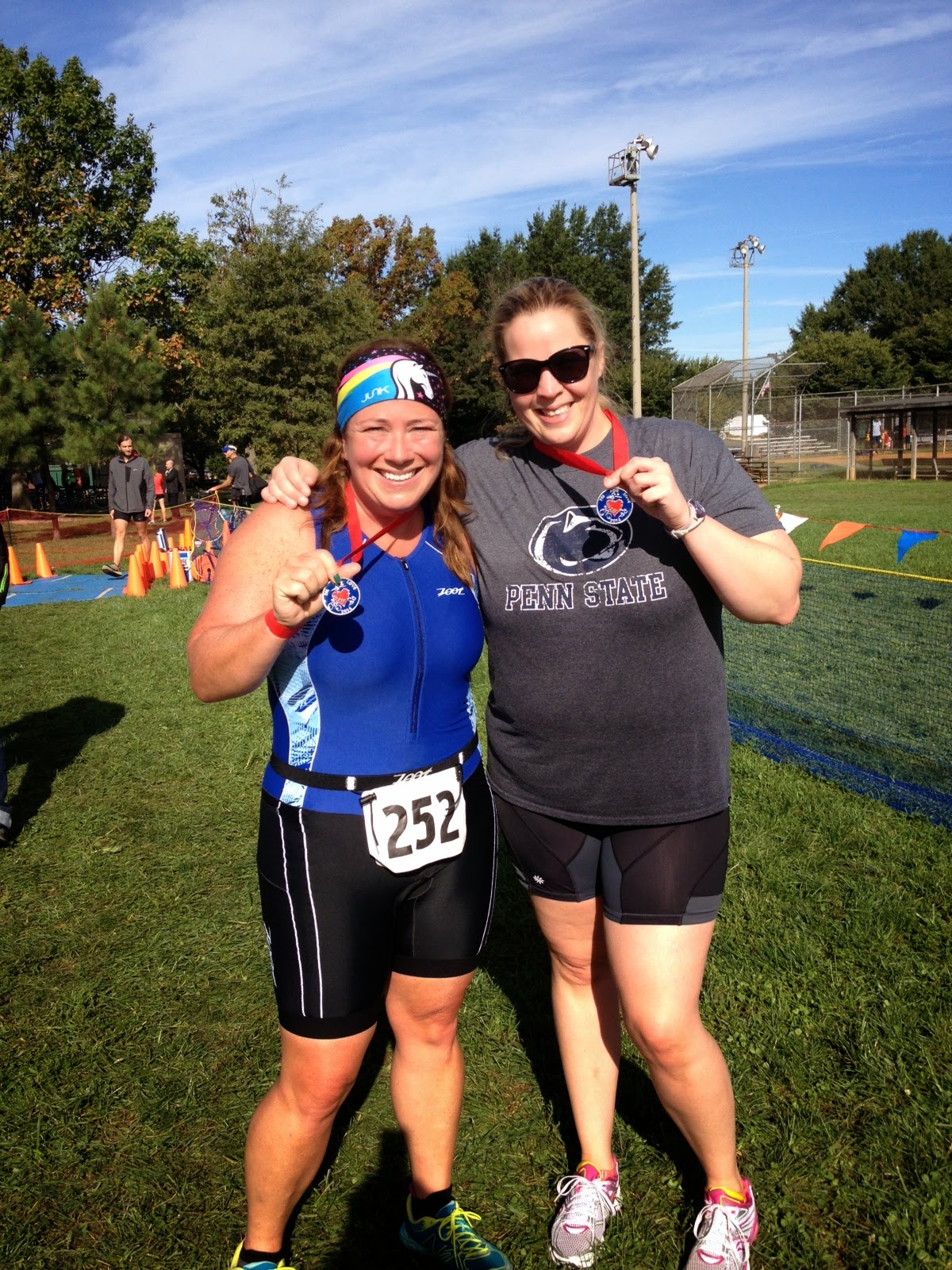
I was about to be body marked for my first triathlon. Which would have been fine if I hadn’t just realized I couldn’t find my bike helmet. I quickly let the official mark my arm and calf with my race number, 252, and then started running back toward my car. Which would have been fine if I wasn’t stumbling through the cold pitch darkness in knee high fur boots. A quarter mile later, I arrived at the car – no helmet. WHERE was my helmet? I now had 30 minutes until the Transition Area was going to close, and 45 minutes to the start of the race. I hauled back toward Transition, still negotiating the darkness and breathlessly begged the DJ/Announcer to ask if anyone had found a silver bike helmet, marked 252.


And so began my Adventure in Triathlon. There’s a lot of gear involved in Triathlon. First you swim, so you start out in a tri-suit or swimsuit, some type of foot wear to get you to the start (fur boots in my case, perfect for a cold autumn 4AM wake up), a headlamp so you can see and a sweatshirt or something to keep you warm. A swim cap and goggles round out your gear for the first discipline. 


Next comes the cycling. First: you need a bike. Then, the previously mentioned missing helmet, sunglasses, bike shoes, socks if necessary, and a belt that holds your bib number (252, remember?). If you’re not wearing a tri-suit, you’re likely going to supplement your swimsuit with bike shorts and a t-shirt and if it's cold, a jacket to wear while cycling. Then you run. Helmet is replaced with a cap or headband, bike shoes changed for running shoes.


In addition to all of this stuff, you likely have a towel to dry off with, a bottle of some kind of liquid nutrition and a bottle of water, maybe a gel or two depending on the length of time you’ll be racing and for me, definitely a chap stick. You can imagine that trying to get all of this gear to the Transition Area is slightly complicated in the early morning darkness. But losing the helmet? Really? Unless you were to lose the bike, it couldn’t get much worse.  I was in a panic. 


Dawn was arriving, my adrenaline was pumping, and my muscles were all warmed up from my unexpected search. The DJ made my plea and someone shouted out that there was a helmet lying on the ground “right over there” and I sheepishly picked it up and made my way back to the Transition Area with 25 minutes to spare.


I knew how to set up my spot in the TA from having obsessively read Your First Triathlon by Joe Friel, and having watched approximately 7,000 you tube videos. The transitions of triathlon are nuanced moments in time. You want to be as organized as possible so you can change gear as quickly as possible and get right out to the next discipline. In fact, Transition is known as the 4th discipline of Triathlon. That's why the Towel & Bucket System seems to be universally used by first timers right up to the pros. It involves laying a towel on the ground and placing your stuff on it in an organized fashion. Then as you finish with each piece of gear, you throw it into a bucket. OK, it’s not really the most technical system but everyone uses it. The TA looks like a sea of bikes with tiny festival blankets laid out beside each, topped with supplies for the day.


I nervously rearranged my chap stick to a new place on the towel for the 6th time and began to chat with the guy and girl next to me. “I’m going for the heaviest bike award today," I stated, horrified at my amazing but reeeeeally heavy mountain bike complete with knobby tires. They laughed and asked me a few questions. I admitted I had no idea what I was doing and that my friend who I was supposed to be racing with had become injured so I was all alone and really nervous but that I was going to try really hard, and in a moment the girl said, “Are you in the on-line running group, My Running Girlfriends?” “YES! ARE YOU!?” I shouted. Was this a virtual friend from my women’s running group on Facebook? “I’m Kim,” she said, “You’re Clythie. I thought that was you!” I was instantly relieved. 

 I had my Love hoodie on for the occasion: Tri4Love, with Kim

I started My Running Girlfriends a few years ago as a virtual running group for women and it’s grown to include friends of friends of friends so there are lots of “girlfriends” in the group who I don’t actually know even though I know all about their running habits and what music they like to listen to when they run and how their races go. Kim had responded to a post I set up when I first signed up for the triathlon. She had done the same one last year as her first tri as well, and she had given great words of wisdom and now, here were both were, having randomly racked our bikes next to each other in the dark on race morning. “This is PJ,” she said, referring to the guy next to her, “And this was his first tri some years ago as well. It’s a really great race and you’re going to be just fine.” PJ chimed in with genuine words of encouragement and all of a sudden the Debacle of the Missing Helmet seemed to fade into the background and I had a feeling that everything was going to be alright.  


My Running Girlfriends played a big part in getting me to the starting line of the triathlon. When my partner in crime, Lauren, became injured, all of a sudden I was doing a race that I was quite intimidated by, alone. Three disciplines in one fell swoop. Three sports that I am alright at but by no means a star. Plus the fourth: Transition. The girls in my running group gave me incredible encouragement and advice. My friend Emily gave me a tri-suit. Annie and Kim had both previously raced the tri I was about to attempt, so they told me all about it, solving the mystery of triathlon logistics. Anne had done other tris and gave lots of advice. Lauretta had finished her first only a few weeks ago and sent me a race report with every question I could have ever thought to ask, answered in perfect detail. I am always thankful to this group of women from around the world, who are always there for each other, even if it’s typically just virtually.


We lined up in the warm pool area in number order. I was 52nd according to my predicted ¼ mile swim time. A respectable mid-pack swimmer.  The RD said to line up and ask the people in front and behind you if they were faster/slower and rearrange yourself accordingly. There was no pretension. Everyone humbly stated swim times, most in my section (8:00 min) that they weren’t sure if they were going to be faster or slower today, and that we should all feel free to tap and pass. I nervously watched the first couple dozen swimmers jump into the pool and swim, 15 seconds apart. Before I knew it, I was jumping in and off for my first snake swim ever, and first competitive swim since my senior year of high school. 

 Pretending like I know what I'm doing in my fancy blue tri-suit, with Kim

A snake swim is basically a long line of swimmers snaking up and down each lane, ducking under the lane line at the end of each lap till you reach the end of the pool and complete a ¼ mile swim.  Unlike an open water swim where everyone is competing at the same time for water space, therefore kicking the crap out of each others heads, arms and legs, you have a half length (+/-) in between each swimmer so unless someone is in the wrong placement order, it’s quite calm. If you consider crushing a quarter mile swim to be a calm affair, that is.


My strategy for the entire race was to take my time and just finish. I know that’s not really the most competitive spirit, but according to Joe Friel, it’s what you’re supposed to do for your first tri, and I'm pretty good at following instructions. So, once I finished the first lap, I slowed down a bit, and relaxed, taking my time cruising along, saving energy for the bike and run. In a flash, I was climbing out of the pool waving to my mom, my husband Jeff, and my best friend and running partner, Matthew. I was on my way to T1, the transition from swim to bike. 

 Making my way out of the pool toward T1

So, T1 was located a bit of a hike on pavement and grass from the pool. I wasn’t sure about running barefoot on pavement, so I tried to walk as fast as possible and then ran once I made it to the grass. Running on pavement and grass was absolutely not part of my training and in fact, I never ever go barefoot. Add that to the list for next time. Practice being barefoot and running on pavement. Wha?? Noted.


I took my time in T1. I was in T1 for 4 minutes. I know! 4 minutes does not seem like a long time to put on sunglasses, take them off because they're fogged up, put them back on, take them off again, hook them into your tri-suit, put helmet on, dry off your feet, shove socks on, shove shoes on, attach your bib belt, chug water and Gatorade, apply chap stick, un rack bike and get out of the transition area, but apparently people do it in one minute.  Whatever. 


All of a sudden, 4 minutes later, I was out on the bike. My bike strategy was to let the bike do as much work as it could for me, push as much as I could and to keep in mind that I had one of the heaviest bikes in the race. The bike was nearly perfect. I finished without a hitch until mile 12ish (of 15) when I could feel my feet going numb. I wondered what I would do when it came time to run. Well, I thought, I’ll walk the bike into T2, and hopefully by then I’ll be able to feel them.  A nice guy passed me on a proper road bike and shouted, “WE’RE ALMOST THERE!” I said, “GREAT!” and he said, “YEAH!! NEXT COMES THE REALLY SHITTY PART!”


The run. I had been looking forward to the run. Of the 4 disciplines, it’s really the only one I feel comfortable doing. I figured I could make up time on the run. Maybe I could pass some people who happened to have fast bikes but weren't really runners.  I shouted back to the guy who was now fading off in front of me, “YEAH, I’M NOT SURE WHAT I’M GOING TO DO BECAUSE I CAN’T FEEL MY FEET.” And I rode in the last 3 miles to T2.


I saw Jeff as I hopped off the bike and then my friend Tora, who to my delight, surprised me by showing up, and when I said to them, “Um, I can’t feel my feet!” Tora said, “Well, you’ll feel them soon enough because it’s time to run!” Good point, I thought. 

 Headed toward T2 with numb feet

I halved my time in T2. I was in and out in just about 2 minutes. I hopped toward the trail. Running would have to wait a bit, because I was concerned that I would break my toes, or completely fall over. Nice, a runner signs up for a triathlon and when it comes to the run, she walks out of the transition area.


About halfway through the run, I began to run. That’s an improvement, I thought. The rest was uneventful in a good way. The trail was easy, and the crowd was roaring as I came into the finish. I passed under the arch, stepped onto the timing mat and immediately saw my friends and family cheering for me. I had finished my first triathlon. I was a snake swimmer on a heavy mountain bike with numb toes and very slow transition times. Fabulous! 

 Success!

 A triathlete!

Friday, May 23, 2014

Crash Course in Pacing


My head hit the pavement so hard I thought I had knocked all my teeth out. I popped up off the ground, adrenaline rushing through my veins, and kept shouting, “Are my teeth ok? Are my teeth ok?” Matthew came running back to see if I was alright, and the look on his face told me that he was surprised I was conscious.

We were 26 miles into a 30 mile run that I was bike pacing, and I had taken a fall off the bike, landing full force on the right side of my head.  So much for rolling into a fall. My hands never left the handlebars.  I guess that saved my wrist from breaking, and the helmet saved my brain quite well too. But the impact was astounding.

After Matthew assured me that my teeth were all still in place, my thoughts turned to the matter at hand. I may have royally screwed up the last four miles of this run, I thought. Pacers are supposed to help the runner, not vice versa, and it was looking like I was the man down.


Ultra runner and coach, Tim Long writes a great blog about running, and in his entry about pacing he calls it “one of the most selfless acts a human can perform.” That certainly wasn’t going to be the case if the guy I was pacing had to carry my bike and me for the last four miles of his long run.

Let me back up. Pacers usually run with an ultra racer, typically for the last half or quarter of a 100 mile run. The pacer is there to help, not hinder, the racer. 

Bike pacing a runner works the same way pacing a runner on foot works.   The pacer leads, goes alongside or follows the runner (runner's choice), offering a predetermined amount of moral support, and company. There are rules about what a pacer can and cannot do, such as mule water or food for the racer, and there are rules about how soon a racer can pick up a pacer, but on this particular day, since it was a training run, we set out together from mile one. It was to be a total of 30 miles, and since I can’t keep up running with Matthew until he is about 70 miles in, I was riding my bike.

All had been going well: there had been no complaints from Matthew, the pace was strong, his body was feeling good and we were cruising to the end. And then I crashed.

As soon as I mentally counted my teeth, I formulated a plan. I would go with the pacers motto of always telling the racer how great he seems/looks, and apply it to myself for the last four miles. That combined with the old adage “if you fall off the bike, get right back on and start peddling again,” helped me to squeak “I’m totally fine, I can ride, no big deal, it’s ok, let’s go!” 

I hurt. My hip hurt, my shoulder hurt, my head now knew the phrase “got my bell rung,” but there was no way I was going to let Matthew know this. For a rather lazy girl, I can be pretty hard core when it comes to pacing.

Not in the dark though. No. Have you ever tried to ride your bike up and down rolling gravel hills on a moonless night without a head lamp? One night, Matthew and I were out on another bike/run, and it became dark before we were able to make it back. And we were in the woods. With a lack of moonlight, and any ambient light being blocked by tree cover, I was flying blind. He was alright. His feet could help him feel each step. I was terrified that I would topple over the handlebars at any moment. Finally, as he disappeared into the darkness ahead of me, I began to walk the bike.  Lesson learned: throw a headlamp into your bag or around your neck if you think you’ll be out anywhere near dusk.     

But the day of The Crash, I was determined. It was the last training run before the Boulder 100 and it needed to have a strong finish. This is why I’m a runner, I thought. You don’t bash your head while running.

Until you do. Another day, I was riding alongside Matthew during a long run with 2 miles to go, when suddenly he hit the dirt with a slam! I jumped off the bike, and looked at him – now lying in the dirt catching his breath. Holy hell! Are you ok, I asked. He said fine, I caught a toe, and he continued to rest there for a few minutes. Turns out, runners can get smashed up too – and they don’t even have helmets on for protection.

The day of The Crash ended well. We finished the 30 miles and ended at a great restaurant where Jeff was waiting for us with food and beverages that we were all happy to enjoy. We might have been a little sore, but there were no complaints because we were looking good, totally fine, and we did it. But it was time to buy a new helmet.